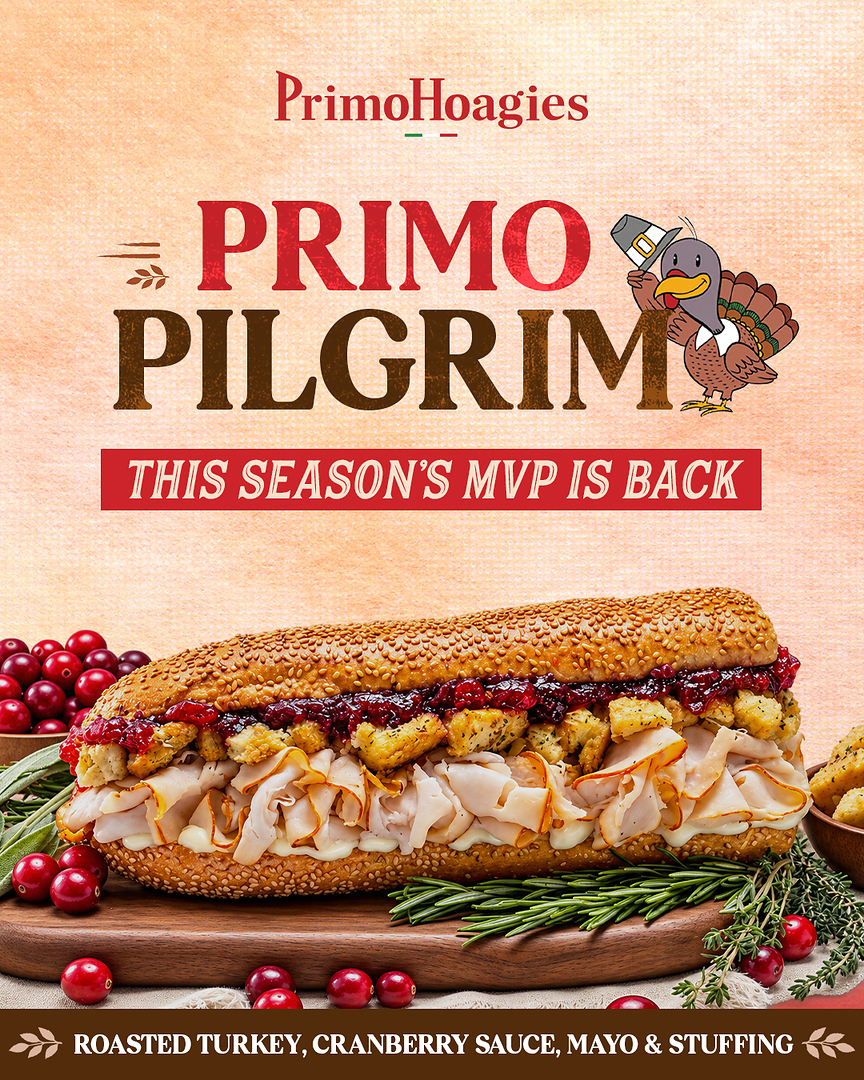
The Philadelphia-rooted sandwich chain PrimoHoagies has relaunched its PrimoPilgrim hoagie for a limited run through November 29 — and layered a catering discount on top of it to convert fan interest into group-order revenue during the NFL season's opening week.
The PrimoPilgrim — built on PrimoHoagies' proprietary golden roasted turkey, homestyle stuffing, cranberry sauce, and mayo on fresh-baked seeded bread — is the brand's primary fall LTO. Its return is timed to overlap the calendar window between early football and Thanksgiving, a stretch that operators in the fast-casual and QSR segment increasingly treat as a distinct catering season rather than a lull between summer and holiday peaks.
The Catering Mechanic
The more operationally notable move is the accompanying catering play. From September 9 through September 13, PrimoPerks loyalty members can apply promo code KICKOFF at checkout — online or in-app — for 10% off catering trays. The discount is app- and web-exclusive, locked to loyalty members, and explicitly excludes third-party delivery platforms. That structure is deliberate: it drives first-party order data, deepens loyalty program enrollment, and keeps the margin hit off aggregator channels where PrimoHoagies would already be absorbing a commission.
For operators watching how regional chains manage catering acquisition costs, this is a clean example of using a short promotional window to pull group-order intent into owned channels rather than ceding it to a marketplace. The five-day window also creates urgency without training customers to expect a standing discount.
What This Signals for Operators
The dual-lever approach — LTO to generate foot traffic and media attention, catering promo to convert that attention into higher-ticket group orders — reflects a broader playbook gaining traction across fast-casual chains. Catering has emerged as a margin-recovery tool for many operators still managing elevated food and labor costs, particularly because a single tray order can match or exceed the revenue of several individual tickets with comparable or lower fulfillment complexity.
PrimoHoagies has been growing its national footprint since its 1992 founding in South Philadelphia, and its loyalty program, PrimoPerks, anchors the catering strategy by gating the discount behind membership. New members who enroll receive a $10 Primo Size Hoagie reward, giving the brand a secondary acquisition hook during the promotional window. The structure mirrors what larger chains have deployed to grow first-party databases ahead of holiday catering season — a period when advance group-order volume can meaningfully offset slower dine-in traffic.
Madalyn Weintraub, Vice President of Marketing for PrimoHoagies, described the PrimoPilgrim as a vehicle that combines seasonal nostalgia with the brand's quality positioning — sliced-to-order proteins, fresh-baked bread — framing the LTO as both a retention tool for existing guests and an introduction point for new ones.
For foodservice operators considering their own fall catering strategies, the PrimoHoagies model offers a replicable framework: anchor a limited-time menu item to an emotionally resonant seasonal moment, then attach a time-compressed group-order incentive that routes transactions through your highest-margin, data-richest channel. The approach pairs well with broader operator intelligence on seasonal LTO timing and connects directly to catering and loyalty program tactics that regional chains are increasingly deploying to compete with larger QSR players.
Written by Michael Politz, Author of Guide to Restaurant Success: The Proven Process for Starting Any Restaurant Business From Scratch to Success (ISBN: 978-1-119-66896-1), Founder of Food & Beverage Magazine, the leading online magazine and resource in the industry. Designer of the Bluetooth logo and recognized in Entrepreneur Magazine's "Top 40 Under 40" for founding American Wholesale Floral, Politz is also the Co-founder of the Proof Awards and the CPG Awards and a partner in numerous consumer brands across the food and beverage sector.