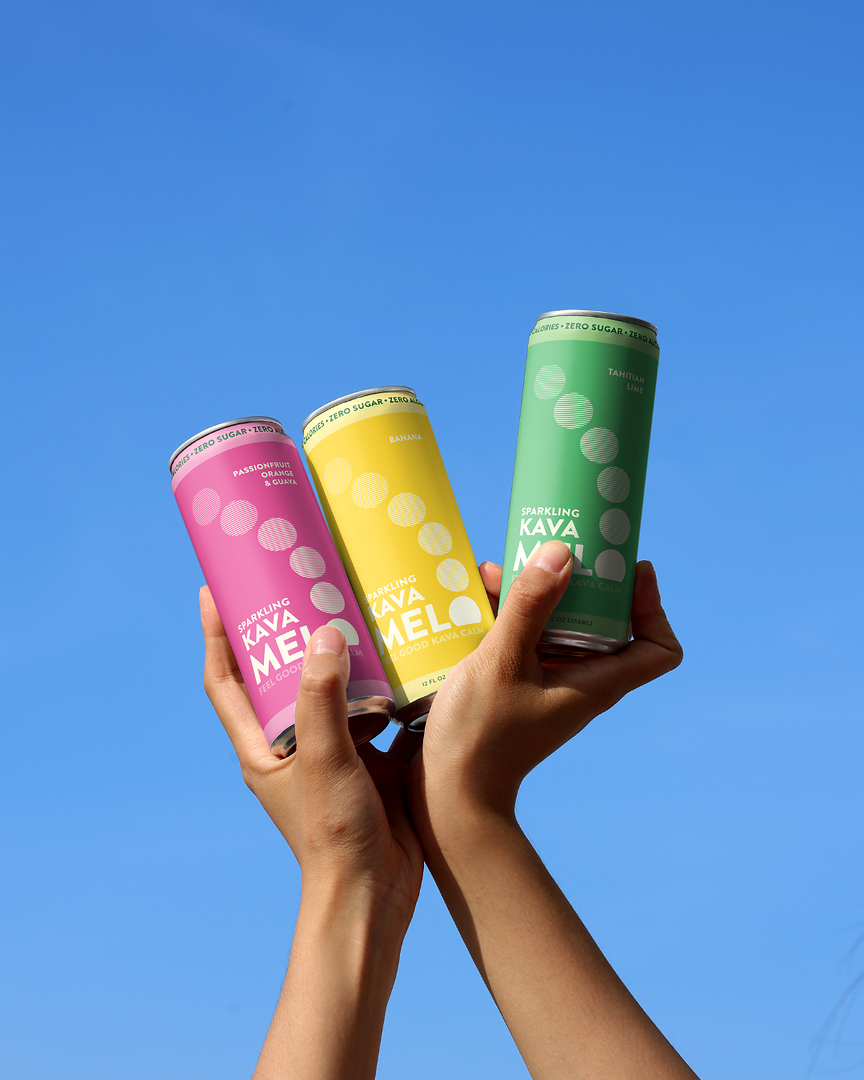
Sparkling kava brand Melo landed its most prominent retail placement to date when it hit the functional beverage coolers at 13 Erewhon Market locations across Southern California on October 30. Two SKUs — Passionfruit Orange & Guava and Tahitian Lime — are available in 12 fl. oz. cans, positioned directly inside the set where adaptogen and functional drinks compete for shelf real estate alongside established names in the energy-and-focus corridor.
The move is worth flagging for buyers, category managers, and hospitality beverage directors because it confirms what regional scan data has been suggesting: the "calm" subcategory is no longer fringe. For years, functional beverage growth was driven almost entirely by energy and cognitive focus. Stress relief and relaxation — while discussed in trade circles — lacked a breakout format. Kava, long confined to specialty kava bars, loose-leaf teas, and tinctures, is now arriving in a shelf-stable, zero-sugar, zero-calorie, vegan, and gluten-free can that fits any natural-channel beverage cooler without buyer objections on format.
Why Erewhon Matters
Erewhon is not simply a prestige vanity placement. The retailer's 14-location footprint in Southern California functions as one of the most closely watched natural-channel proving grounds in North America. Brands that move volume at Erewhon have a documented track record of converting that proof into mid-tier natural and conventional chain conversations. Melo's current distribution — which already includes Raley's, Bristol Farms, BevMo!, Thrive Market, Gopuff, and Amazon — suggests the brand is building a multi-channel story rather than relying on a single retail anchor. The Erewhon entry sharpens the premium credential while the broader mix validates velocity across multiple shopper profiles.
For operators evaluating non-alcoholic beverage programs — whether in hotel minibars, restaurant mocktail menus, or café coolers — Melo's sourcing story is a practical differentiator. The brand works directly with family-owned farms in Vanuatu and holds official private-sector partner status in the UN and International Trade Centre's Pacific Islands Kava Initiative, a program focused on improving quality standards for kava-growing communities. That traceability narrative is increasingly useful in menu storytelling and buyer deck conversations.
What This Signals for the Category
Amy Betts, co-founder and CEO of Melo, framed the launch around a shift in consumer intent that buyers should take seriously: "For a decade, the functional beverage market has run on the go, go, go mentality of energy drinks, but now what people actually want is permission to slow down." That shift is showing up in category data and in the number of new SKUs entering the relaxation and sleep-support lane across both beverage and supplement channels.
For procurement teams and beverage directors building or refreshing a non-alcoholic program, the Erewhon entry signals that kava is moving from a niche interest to a buyer-ready category with mainstream shelf logic. Brands in this lane are positioning against alcohol reduction trends, the sober-curious movement, and consumer fatigue with high-stimulant drinks — three durable tailwinds with direct relevance to on-premise and retail hospitality channels alike. Operators who have not yet reviewed their functional beverage procurement strategy or evaluated non-alcoholic program opportunities should treat this placement as a category signal, not just a brand announcement.
Written by Michael Politz, Author of Guide to Restaurant Success: The Proven Process for Starting Any Restaurant Business From Scratch to Success (ISBN: 978-1-119-66896-1), Founder of Food & Beverage Magazine, the leading online magazine and resource in the industry. Designer of the Bluetooth logo and recognized in Entrepreneur Magazine's "Top 40 Under 40" for founding American Wholesale Floral, Politz is also the Co-founder of the Proof Awards and the CPG Awards and a partner in numerous consumer brands across the food and beverage sector.