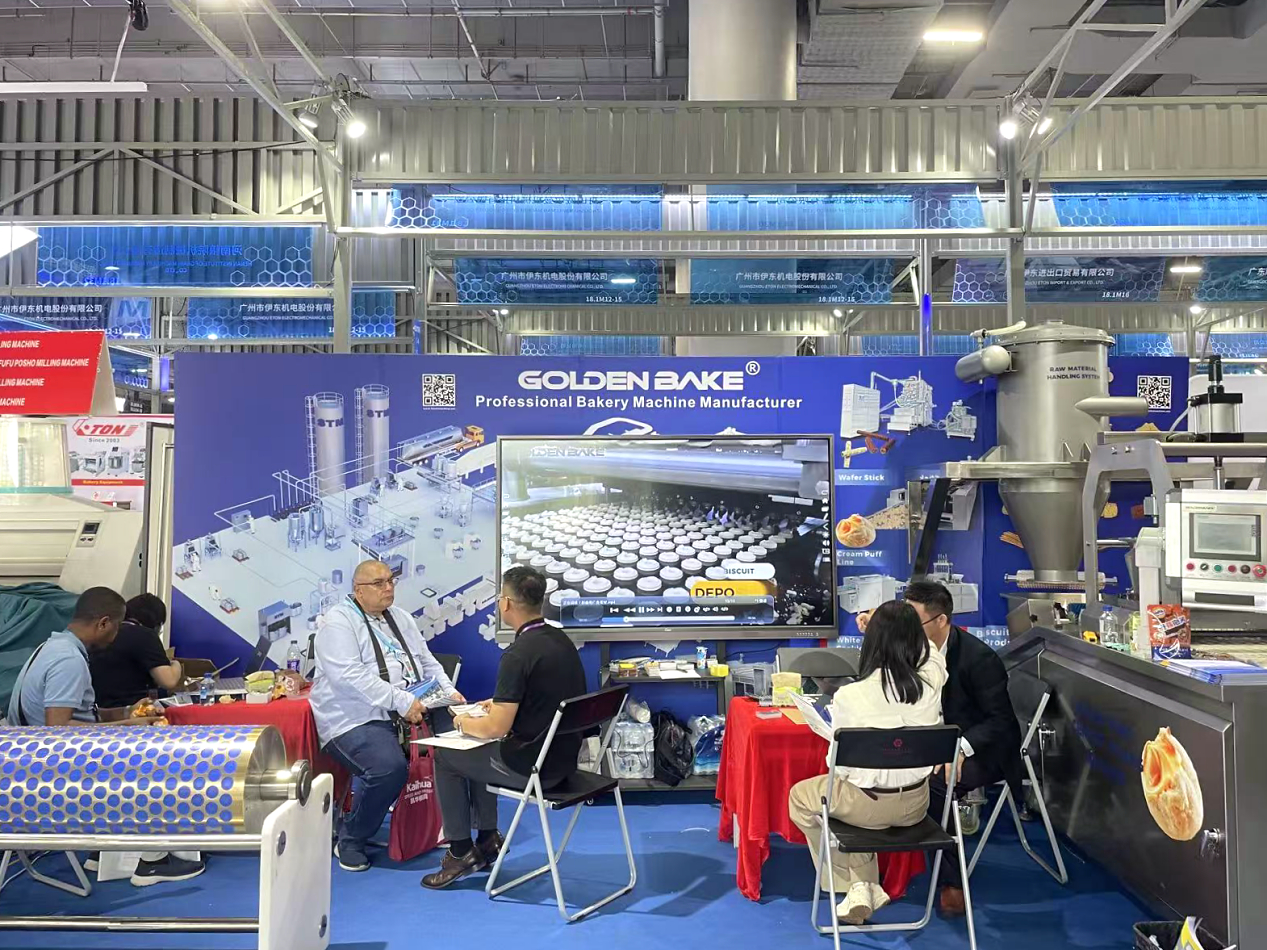
Industrial biscuit manufacturers are losing productivity before the dough ever reaches the mixer — and Golden Bake, the baking equipment division of Evergrowing Machinery Company Limited, used the 140th Canton Fair to show how far automated ingredient handling has come as a cost-control lever.
The company presented a 3D model of a fully integrated production line connecting intelligent silos, automated dosing, and pneumatic conveying to mixing, forming, and baking in a single synchronized workflow. For operators still running manual tipping and hand-weigh stations, the gap in labor cost and food-safety exposure is widening.
The Dust and Dosing Problem
Flour dust is not a minor nuisance — it is a classified flammable hazard under U.S. OSHA guidelines, and uncontrolled manual flour handling creates both safety liability and product-consistency risk. Golden Bake's feeding station combines bag emptying, 30-mesh sifting, and dual-suction negative-pressure dust extraction capable of processing up to 50 kg of flour per minute. A pulse-cleaned cartridge separator with food-grade anti-static filter media and a rotary valve at the hopper base handles the screening load. Pneumatic conveying then moves flour through sealed pipes — across floors if needed — in compliance with Chinese explosion-proof standards GB 50058-2014 and AQ 3009-2007.
On the dosing side, the company's automated ingredient handling system uses a PLC and HMI touchscreen to control a 1,000 kg automatic weighing hopper. The tested tolerance is ±200 grams per cycle, with a cycle time of approximately 3 minutes for a two-flour recipe. A Golden Bake food technologist noted that even small ratio shifts in mixed-flour recipes affect water absorption, dough strength, and forming performance — compounding into visible texture and thickness defects at high volume. That concern tracks with industry data: according to Baking Business, 59% of respondents to a 2025–26 industrial bakery capital spending survey cited quality, consistency, and precision as key investment objectives for 2026.
Retrofit vs. Greenfield
The more operationally relevant question for most buyers is not whether to automate, but whether to retrofit existing lines or invest in new capacity. Baking Business reported that 32% of surveyed bakery enterprises are focused on upgrades and retrofitting, while 22% plan to add new equipment or lines by 2026 — a split that Golden Bake's modular architecture is positioned to serve on both sides.
The feeding system can be configured around existing plant layouts and equipment. For operators building out new facilities, Golden Bake also offers turnkey factory solutions covering facility planning, equipment layout, installation, and on-site commissioning. PLC-controlled scheduling integrates parallel liquid dosing — oils, water, and additives metered to recipe — so mixers are not waiting on any single ingredient stream. Cookie lines and cracker lines can be configured differently: the former prioritizes ingredient addition order; the latter may require staged mixing and fermentation modules.
What This Signals for Procurement
For food and beverage operators sourcing or speccing biscuit production capacity, the Canton Fair appearance signals that ingredient automation is no longer a premium add-on — it is becoming a baseline expectation from global equipment suppliers. The OEE framing Golden Bake is using (overall equipment effectiveness, extended asset life) mirrors the language procurement teams at large snack manufacturers are already applying to capex justification.
Operators evaluating equipment vendors should ask specifically about explosion-proof certification compliance for their local jurisdiction, recipe data portability from the HMI, and whether the modular system carries commissioning support in their region. Golden Bake reports more than 3,500 production lines installed across 30-plus countries — a footprint that suggests service network depth, though operators outside Asia should verify local support coverage before committing. For operators tracking the broader equipment and hospitality technology landscape, or benchmarking against food and beverage industry procurement trends, ingredient automation is a fast-moving category worth monitoring in this capex cycle.
Written by Michael Politz, Author of Guide to Restaurant Success: The Proven Process for Starting Any Restaurant Business From Scratch to Success (ISBN: 978-1-119-66896-1), Founder of Food & Beverage Magazine, the leading online magazine and resource in the industry. Designer of the Bluetooth logo and recognized in Entrepreneur Magazine's "Top 40 Under 40" for founding American Wholesale Floral, Politz is also the Co-founder of the Proof Awards and the CPG Awards and a partner in numerous consumer brands across the food and beverage sector.